TalentHubTH Brief: Use this guidance together with the actual role, industry, location and business context.
Quick answer: what should a company prepare?
Prepare a clear and complete source file and identify the machine model, source and target languages, intended users, purpose and required delivery date. Include an approved glossary, part names, diagrams and earlier reference documents where available.
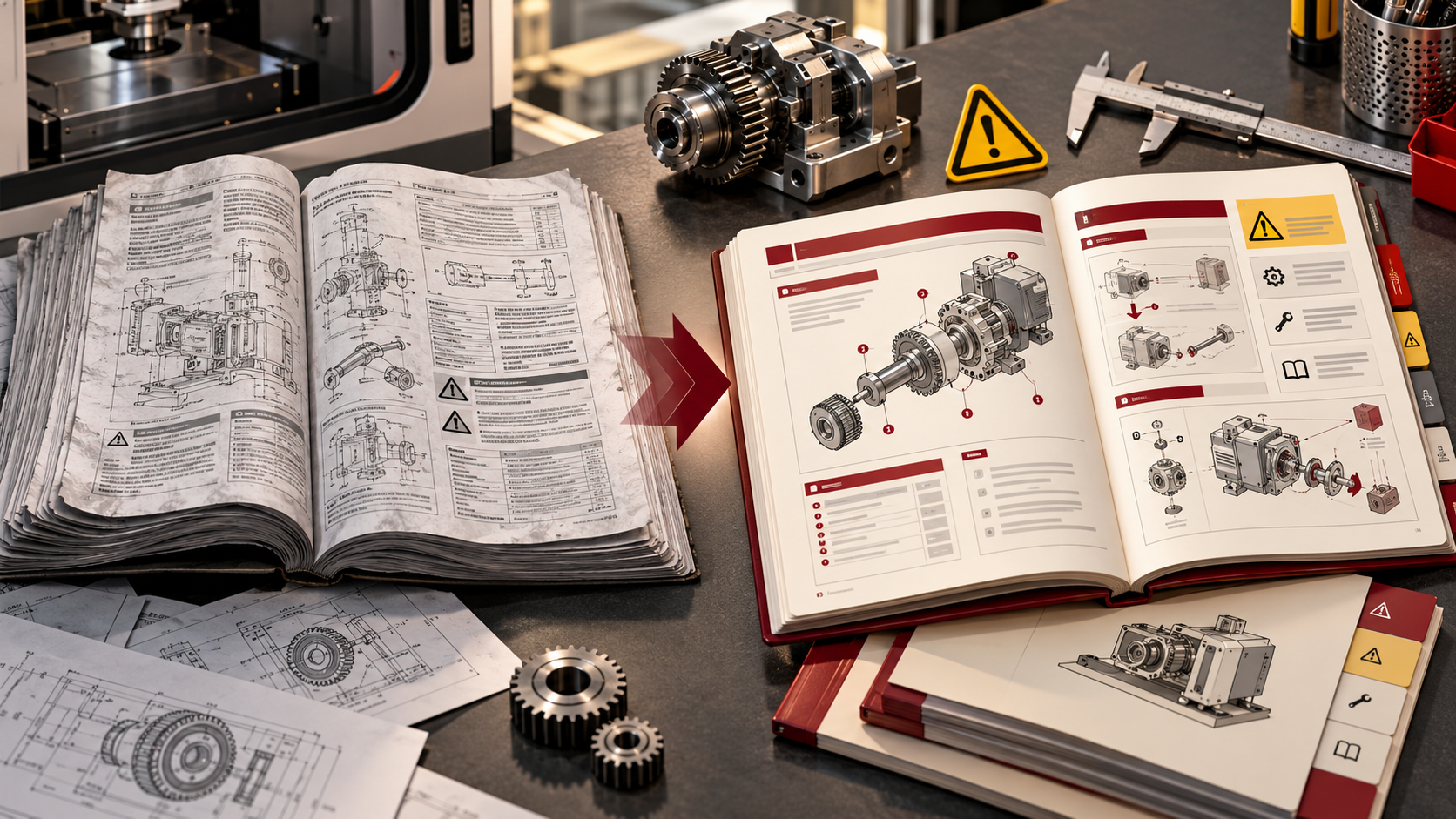
Tell the provider at quotation stage whether the Thai document must match the source layout. Translation, OCR, editing text embedded in images, desktop publishing and a print-ready file are separate production tasks. Engineers or the responsible machine owner should recheck figures, units, warnings and technical procedures before use.
What types of factory documents can be translated?
Machine documentation is not limited to a full operating manual. Each document has different users and a different risk level, so identify whether it is for general reference or controls actual work.
- Installation, operation, maintenance and troubleshooting manuals
- Spare-parts lists, drawings and machine diagrams
- Control-screen messages, alarm text, warning plates and labels
- Work instructions, SOPs and inspection checklists
- Training documents, acceptance records, test reports and warranties
- Supplier documentation and relevant safety data sheets
Why is a machine-manual translation different?
The same term may have a different meaning depending on the machine and process. Moulding, pressure, pneumatics, welding, settings and temperature control all require context. A translator should see the component, button or diagram to which the text refers.
Manuals also contain voltage, current, temperature, pressure, weight, dimensions, speed, tolerances, time values and part codes. A misplaced decimal point or incorrect unit can change the instruction.
Danger, Warning, Caution and Notice should follow a consistent hierarchy. They should not be interchanged casually because they indicate different severity and required responses.
Which source-file format is best?
Editable files such as Word, PowerPoint, Excel, InDesign, Illustrator or the original manual-authoring format reduce text-extraction errors and make layout work easier.
A searchable PDF is still useful for word-count assessment. A scanned PDF or photograph requires additional checks for clarity, missing pages, skew, cropped text, OCR accuracy and the need to rebuild tables or diagrams. It may therefore cost more and take longer even when the page count is the same.
Information required for an accurate quotation
A page count alone is not enough. One hundred pages of running text require a different production process from one hundred pages containing exploded diagrams, tables and embedded labels.
- Source language, target language, page count and number of files
- Machine type, industry, intended use and reader group
- Source-file format and required deliverable format
- Whether source-like layout, image translation or print-ready output is required
- Deadline, glossary and existing reference material
- Confidentiality or NDA requirements
- Review rounds and the client's technical contact
Translate directly from Chinese or through English?
Direct Chinese-to-Thai translation is usually preferable when the Chinese manual is the controlled source, the manufacturer is Chinese, no English version exists or the English file is machine-translated. It reduces the risk created by translating through an intermediate version.
English-to-Thai may be appropriate when the manufacturer confirms that English is the official manual, the company uses English terminology internally or the machine interface is in English. When both files exist, provide both for comparison and ask the manufacturer which version controls when they conflict.
Why create a glossary before translation?
Large projects and document sets benefit from an approved glossary that lists the Chinese term, English reference, authorised Thai term and a usage note. For example, 急停按钮 may be standardised as Emergency stop button / ปุ่มหยุดฉุกเฉิน, and 控制柜 as Control cabinet / ตู้ควบคุม.
A glossary keeps component names and instructions consistent across manuals, labels, screens and training material. It also reduces later revisions and can be reused for future machine models.
How should safety warnings be translated?
A warning should preserve the nature of the hazard, when it occurs, the potential consequence, the preventive action, whether power must be isolated and who may perform the task.
Do not shorten a detailed instruction such as 'Disconnect the power supply before maintenance' into a generic 'Be careful'. Safety information and instructions should be presented in a language and format that workers can understand.
Can AI or machine translation be used?
Automation can assist with a draft or a large volume of repetitive text, but the output should not become an operating manual without review. Errors may include using terminology from the wrong field, dropping a negative, reversing greater-than and less-than, losing figures or units, inconsistent part names and weakening or exaggerating warnings.
A safer process uses technology as an aid, followed by a translator's source comparison and a technical review by the company's specialist before final approval.
Who should review the document before use?
A translator or language reviewer checks meaning, completeness, readability, terminology, numbering, cross-references, figures, units and omissions. The company's engineer checks part names, installation, settings, tests and maintenance procedures.
Safety personnel check warning plates, energy isolation, personal protective equipment, prohibitions and emergency procedures. Actual operators should then test whether they can find the right section, connect instructions to diagrams, follow the sequence and distinguish warnings from general information.
Translation and desktop publishing are different scopes
Confirm exactly what the quotation includes, especially for scanned PDFs with many tables and images.
- Text translation only: an ordered Word file or translated text
- Translation with layout: a Thai document formatted close to the source
- Text inside images: edited or recreated Thai graphics
- Desktop publishing: pages, tables, fonts, numbering and contents pages
- Print-ready file: a PDF in the agreed size and specification
- Bilingual file: Chinese–Thai or English–Thai side by side
- Glossary and translation memory for future documents
What affects price and delivery time?
Send the actual files for assessment rather than relying on page count alone.
- Word count, pages, files and language pair
- Technical specialisation and source-file quality
- Tables, diagrams and text embedded in images
- OCR, layout and bilingual production
- Review rounds and additional specialist review
- Urgency, NDA terms and output format
Pre-translation checklist
Use this list before requesting a quotation and starting production.
- Confirm the machine name, model and latest controlled source
- Check that pages are complete and correctly ordered
- State the language pair, readers and intended use
- Specify output format, layout and image-text requirements
- Attach the glossary or previous approved translation
- Name the person who will answer technical questions
- Define review, approval and revision rounds
- State the deadline and confidentiality requirements
- Keep source and translation versions separate
- Arrange engineering and operator testing before release
Summary
Translating a Chinese machine manual into Thai is not simply replacing one language with another. The relationship between instructions, diagrams, figures, units, part names and warnings must remain intact.
Provide a clear source, state the purpose and reader group, standardise terminology and appoint a technical reviewer before work begins. When translation is complete, test it with actual users before approving it as a controlled document.
Send a sample file to TalentHubTH
TalentHubTH provides Chinese, English and Japanese document translation and can assess translation, layout and output requirements for manuals, factory documents and work instructions.
Send a sample, language pair and deadline for a scope assessment and quotation. LINE Official: @talenthubth, telephone 066-059-9440, or email talentshubth@gmail.com. TalentHubTH does not certify engineering information on behalf of the manufacturer or the client's technical specialists.
Frequently asked questions
Is a machine-manual translation priced per page or per word?
It depends on the file and scope. Searchable documents may be priced by word count, while scanned PDFs, tables and image text need assessment based on complexity and production time as well as pages.
Can I send only a PDF?
Yes, if it is clear and complete. A scanned PDF must be checked to determine whether OCR is reliable or whether the text must be recreated manually.
Can only the pages used by operators be translated?
Yes. A company may create a short guide for daily operation, cleaning, changeovers or alarm handling, but it should be labelled as an extract rather than a complete manual.
Can machine-screen text be translated?
Yes, when a text export, terminology table or clear screenshots are available. Provide character limits and the required import format.
Does translation include an engineer's review?
Do not assume that it does. Check the quotation. A translator reviews the language; machine settings and engineering procedures should be approved by the manufacturer or the company's technical specialist.
Should both the Chinese and English manuals be supplied?
Provide both when available so terminology and missing content can be compared, but identify which file is the controlled source.
Can TalentHubTH review an AI translation?
The scope can be assessed after seeing the complete source and translation. A poor AI draft may require more correction than translating again from the source.
How long does the work take?
Timing depends on word count, technical complexity, layout and the technical-review process. The actual files should be assessed before a delivery date is confirmed.